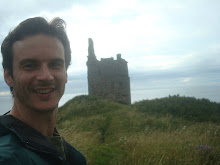
Thursday, July 5, 2007

Back from the Dig!

To sum up the last two weeks: "Rite crackin' brilliant!"

What more can a fellow ask? Surrounded by ancient ruins, digging in the muck, castles, caves, plenty of scones.

The Arbeia Roman fort is located on a hilltop in the town of South Shields, England. For those that don't know, it is on the eastern end of Hadrian's Wall at the sea, fairly close to the Scottish border. This means that not only do the people speak in a dialect which requires a certified code-breaker to understand, but that it also rained EVERY SINGLE DAY! I, of course, thought this was cool (picture an army of barbarians running down a rain-slicked hill) - but for the average tourist I'm sure this causes numerous complaint letters to the weather bureau.
The fort itself was built around 160 AD. It was a conventional fort for a while, but around 200 AD it was converted into a supply base for Hadrian's Wall, with food granaries replacing a lot of the barracks. In the picture below, you can see the stone foundations of some granaries peeking out on our dig site. Notice how far down they are below the surface!


The fort was also expanded, with the original south wall being torn down and a new one built further out. I was on the team which exposed the stone foundation of that original south wall, so it was cool to see that early work. We spent many hours tediously removing clay from the stones, and in the picture below you can see the fully exposed foundation. Pretty groovy!


The group which came to the site was fantastic. People from all walks of life, mostly American. They were hard working, fun, and a pleasure to meet. Even though the weather was hard, people kept their chin up and pulled through like troopers. There was also a great sense of humor amoung the group, and we spent hours laughing and hanging out. Unfortunately there were a couple people who, for some reason, acted somewhat immaturely (imagine being an adult and still think it's cool to make snarky comments, etc). It was quite amusing to witness, actually. But this wasn't typical of the group, the rest of the people were great!

And, of course, The staff was amazing. They were all experts, and I tried my best to learn as much as I could, like a giant nerd sponge. In addition to the actual dig, they provided lectures on the site's history, Roman history, pottery, Hadrien's Wall, etc. The site had reconstructed several buildings, included barracks and headquarters. In the picture below you can see the reconstructed Roman gate. If you want to keep your neighbors out, try one of these suckers.


Well, that's all for now - I'll add more later. I leave you with a picture of the coastline at South Shields. Yes, you can actually hear a full chorus when you get to the cliffs....


Friday, June 15, 2007

Heading to the Past!

Hello All,
I am going on an archaeological dig in England, and will be gone until July 5. It is at a Roman Fort in South Shields, and should be "brilliant" as they say. I can't think of a better way to spend two weeks than digging in ancient strata! Fun, Fun! I am looking forward to lots of history, working with the fellows over there, exploring, and maybe a ghost legion or two marching around at night. I will be sort of lost in time for a while, so see you when I get back. Urbem latericium invenit, marmoream reliquit!

Tuesday, June 12, 2007

The Continental Army: Don't Forget your Toothbrush!


On June 14th, 1775, the Continental Army was created by the Second Continental Congress to form a unified force against the British. The British, for their part, generally reacted with full belly laughs and extra rounds of tea. You see, up until that point, the Patriots' military capability had generally been militia, which according to Mel Gibson had lots of guys with bad teeth and penchants for eating dogs. To be sure, there was no unified army to back up the will of the Patriots until the Continental Army was formed. This could have been quite embarrassing - showing up to battle with no color coordination (imagine a line of British Officers simultaneously humphing).

So what happened exactly during those couple months? Well, in keeping with the spirit of the make-shift army, here is a make-shift timeline:

- April 19th, 1775: Massachusetts Militia face off with British forces at Lexington. The British were attempting to destroy a weapons depot gathered by the colonists, which, as anyone who has tried to take a gun away from an American, is a "no-no". Before this, of course, there were a bunch of acts passed by the British Parliament, "outrages", people dressed as Indians, soldiers in homes, etc etc. I won't get into it, but suffice to say people were a little "put out."

- At Lexington someone fires an unordered shot (shot heard around the world). The British fire back, charge, regroup. Later, Militia attack the British force at Concord. Word gets out, all hell breaks loose.

- May 10, 1775 American forces led by Benedict Arnold and Ethan Allen capture Fort Ticonderoga in NY. Note that at this point there was still no official army.

- May 10, 1775 Second Continental Congress convenes in Philadelphia. John Hancock elected president with his giant, raving pen.

- June 14th, 1775 Congress establishes an official Continental Army. "Be all that thou can Be," as it were.

- June 15th, 1775 Congress unanimously votes to establish George Washington as commander-in-chief of the army. Washington accepts no payment other than expense compensation - take that, modern Congress!

- June 17th, 1775 The Battle of Bunker Hill - first major battle of the war. To make a long story short: British take the hill, but on the way lose over 1000 men. Continentals lose about 400.

- July 3rd 1775 Washington takes command of the Continental Army gathered at Cambridge, Massachusetts. He describes it as a "Mixed multitude of people...under very little discipline, order or government." But eventually, ol' Washington whips them into shape.

Well, the rest, as they say, is history. It is interesting to note that two days after Washington took command, Congress passed the "Olive Branch Petition," which was a direct appeal to the British for peace - so even then there was hope for a resolution. This was not to be however, as George III rejected the petition and claimed the colonies in "open rebellion."

Big mistake.

Wednesday, June 6, 2007

Today's Random Artifact Trivia: Now with Exploding Cannonballs!

If you are like me, you spent weekends as a kid looking for ancient treasure, fighting dragons, and generally exploring - possibly with a phaser blaster. Also, if you are like me, you do this well into your thirties (except now dragons are on the protected list). At any rate, whatever your means of enjoyment, there is one thing we can all agree on - a 50-55% RH level is decent for mixed collections. I know, I don't have to tell you - you are reading your HOBO environmental monitoring equipment in your home closet as we speak - checking the list, adjusting the HVAC (which you installed in your house instead of going to Fiji). So in that spirit, here is some artifact trivia to discuss on your next first date (if you really want to impress, wear white curator gloves and ask your date not to touch the good china).

- Nails did exist in ancient times. The idea that nails didn't exist may come from the fact that nails were expensive (try making them sometime) and pegs were often used.

- Native Americans have been on this continent for over 11,000 years, possibly longer. Some archaeologists claim to have found tools dating to 50,000 years ago, although this has been highly debated. In general, the earliest culture is referred to as "Clovis", and the spear/knife points have a distinctive "Gothic arch" look to them - check it out: http://www.sdsmt.edu/wwwsarc/collectn/stone/clovis.html

- The great cannonball question - Do they explode? Well, the answer is some of them do, some don't. Many cannonballs (or "roundshot" for the nerds) were hollow on the inside with a fuse/plug that was ignited when the cannon fired, this would burn and eventually ignited the charge inside. Think "Bombs bursting in air". Some cannonballs, however, were solid and used to batter ship hulls or take out fortification walls. It's a matter of taste, really - do you prefer pretty explosions or splintering wood?

- Lincoln Logs were invented by Frank Lloyd Wright's son, John Lloyd Wright in 1916...."So, your father was a famous architect. What have you ever done?"...."I invented Lincoln logs. Ever heard of them?"

That's all for now. I'm sure you have written all this down and stored the paper in proper archival sleeves. Someday, centuries from now, they will find your notes and store them in even more proper archival sleeves. With full humidity control, of course.

Saturday, May 19, 2007

Today's Museum Tip: More Than a Rock?


You are at the most important dinner of the year. A 40-foot solid mahogany table is filled with investors who hold the fate of your small business in their powerful, cigar-stained hands. The conversation has become embarrassingly mundane, and you can see all your efforts and hard work collapsing like a failed Jinga tower. Mr. Cotton-Matherstein III just yawned for the forth time, and the widow Muffy Marmensok is starting to inhale wine like a beluga whale cruising for plankton.
Suddenly it occurs to you how to save the day. 'Of course!' you think, grabbing a fork and tapping loudly on your rented crystal glass.

"Ladies and Gentleman" you exclaim, face afresh and eyes sparkling "I know how to tell if you found an arrowhead!!!"

Energy cascades through the investors, their bodies shifting as they eagerly await this new and important information. Mumbling occurs - positive mumbling - as heads nod and attention focuses. Now, young entrepreneur, here are some quick facts about arrowheads:

- Actually, most of the "arrowheads" you find are not arrowheads at all, but spear-points or atl-atl points. The bow wasn't invented until relatively late in the Native American time-table (about 500 AD), so for most of their history they were using spears or atl-atl darts. For true nerdness, call them "projectile points".

- Look for percussion flaking marks - these are little indentations on the surface formed during fabrication. Native Americans would not have bothered to smooth the surface.

- Look for sharp edges and tips. Projectile points were made to kill - sometimes you will find a rock that is shaped like a point, but with thick edges and the like. Ask yourself - if it is placed on the end of a spear, could it easily penetrate your skin? (note: for all young male readers, do not try)

- With that fancy "internets" thing, archaeologists have amassed a large amount of reference data referring to point type and location. This data can generally be used to accurately date a point if the location is known, and is a great way to identify your find. Here is an example site: http://www.arrowheads.com/

Congratulations, you have now saved the day! The investors are abuzz with excitement, and Muffy is already talking about new boots for her arrowhead-finding expeditions. Perhaps your business can expand, and you can buy that townhouse in Tampa. Now, if you only knew what an atl-atl was.

Memorial Day: A little History, A Lot Of Honor


Before I begin, the picture to the left is my Grandfather, Robert Kearney. He was a communications officer aboard a B-25 Bomber during WWII, and one of the greatest men to ever grace this planet. More coming on that in another post.


My mother recently told me something very interesting. I know what you are thinking - I was found in a tree stump, given up by trolls. No, you are wrong! And shame on you for thinking such a horrible thing (we all know I was left by gypsies). In actuality, she listed all the Memorial Day services being held in her community on the 28th. Why is this cool? Well, I don't have to tell you, it seems.

You see, there is great hope for our society. Sometimes popular culture celebrates the actor pretending to be a soldier more than the actual soldier. However - we as individuals do NOT, and this is very important. We all have our guilty pleasures - American Idol, Desperate Housewives etc. Mine is Buffy the Vampire Slayer (that's right, proud member of the Scooby Gang). But when it comes down to it, I bet any one of you would honor the soldiers who died for our country more than all of Hollywood combined. The media can throw what it wants at us, it doesn't matter - it's shaved Britney Spears' heads, it's pompous clothes designers snapping their fingers, it's American Idol rejects crying and running amok outside the audition room. Throw it all! In the end we all know, and always have known, what is most important in life.

That is America. We love the absurd and cherish the significant. We laugh at mundane sitcoms, yet stand and honor those who truly deserve it. We are a great people, sometimes we just need to remember.

For the 28th, Here are some quick facts about Memorial Day:

- Memorial Day began as a result of the Civil War. Various communities held services for the fallen, with veteran groups often leading the way. One of the earliest ones began in 1866 in Waterloo, NY (the official "birthplace" of Memorial Day), held on May 5th annually.

- As leader of the Veterans group "The Grand Army of the Republic," General John A Logan led the call for a national Memorial Day. On May 5th, 1868, Logan declared a national "Decoration Day" to be held on May 30th every year. That date was chosen because it was not the anniversary of any particular Civil War battle.

- At first, many Southern States refused to celebrate Decoration Day because of continuing hostility toward the North, although they held their own Confederate Memorial Days. This changed, however, after WWI as many of the veterans were from the South.

- The name "Memorial Day" was not used regularly until after WWII. Decoration Day likely came from the tradition of decorating soldiers graves with flowers and other items. Southern women's groups were particularly involved in this practice, and set an example for the rest of the nation.

- In 1968 Congress passed the "Uniform Holiday Bill" which moved four holidays to Mondays: President' Day, Columbus Day, Veteran's Day, and Memorial Day. This was done to create three day weekends, and moved the date of Memorial Day from May 30th to the last Monday of May. This may have inadvertently led to the dwindling of Memorial Day celebrations, as Americans became distracted by the three day weekend.

- Memorial Day specifically honors US soldiers that have fallen during military service. This is not to be confused with Veterans Day, which largely honors and thanks our living veterans.

- Since the 1950's, the 3rd US infantry places American Flags at all of the Graves at Arlington National Cemetery, then patrols the entire weekend to make sure the flags stand.

- Every year, the Boy and Girl Scouts place candles at each of the 15,300 graves at Fredericksburg and Spotsylvania National Military Park

- In 2000, the "National Moment of Remembrance" resolution was passed by Bill Clinton to ask for a voluntary moment of silence at 3:00 pm by all Americans each Memorial Day.

- In 2004, Washington DC held it's first Memorial Day Parade in 60 years.

Even with the best intentions, it is sometimes easy to forget Memorial Day with today's fast moving society. We all have done it, or at least not celebrated it as much as we should have. But we don't have to be perfect...America isn't perfect, and it is not supposed to be. America gives us the freedom to better ourselves, and perhaps that is most important of all. On Memorial Day, lets try to remember the men and women who died for our country.


"We cherish too,
the Poppy red
That grows on fields where valor led,
It seems to signal to the skies
That blood of heroes never dies."

- Miona Michael, 1915

Friday, May 18, 2007

Where has the time gone?

Am I getting old? - I found a track from my band "Sugar Lloyd" from back in the day. This was recorded live at "Kilroys" around 1992.
http://www.jarodkearney.com/sitebuildercontent/sitebuilderfiles/track.mp3
I wonder if the place even exists anymore. I know what you baby-boomers are thinking - "It wasn't THAT long ago, fella." But to me it seems like a century.
At any rate, The guitarist (Dave McCracken) is now a well-known key-boardist, playing his heart out with Donna the Buffalo and all kinds of cool bands. The drummer (Brad Lloyd) is now an amazing Jazz drummer, playing with all kinds of big names. I'm not sure what the bassist (Matt Webb) is doing these days, but if anyone knows drop me a line. The singer? Well, I'm the nerd with the artifacts. Although musically, I'm learning the banjo these days. It's a lot of fun, and I figure I'll be pretty good by the time I'm 80.
(Note: the song is a live jam, with it going from very loud to practically hearing nothing. Just so you won't be startled when it suddenly comes back in!)